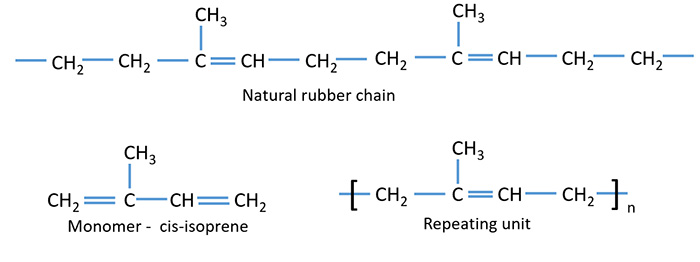
Natural rubber ch 2 ch c.
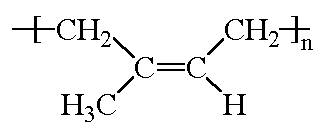
Monomeric unit of natural rubber.
B natural rubber is soluble in organic solvents such as benzene petrol carbon disulphide and chlorohydrocarbons.
Isoprene has also been detected in tobacco smoke and it is the monomeric unit of natural rubber and naturally occurring terpenes and steroids.
Polyisoprene polymer of isoprene c 5 h 8 that is the primary chemical constituent of natural rubber of the naturally occurring resins balata and gutta percha and of the synthetic equivalents of these materials.
Most synthetic rubbers do not need.
Mastication is a process in which molecules are physically or chemically shredded to make mixing and processing easier.
2 buna n nitrile rubber it is obtained by polymerization of 1 3 butadiene acrylonitrile in the presence of a peroxide catalyst it is used for making oil seals manufacture of hoses tank linings.
3 dacron it is obtained by the polymerization of ethylene glycol terphthalic acid.
Here the monomeric units are distributed randomly and sometimes unevenly in the polymer chain.
Depending on its molecular structure polyisoprene can be a resilient elastic polymer as in the case of natural rubber and isoprene rubber or a tough leathery resin as in.
A the long hydrocarbon chains of natural rubber cannot dissolve in water.
A when it is warmed above 50 c it softens and becomes sticky.
For carbohydrates the monomers are monosaccharides.
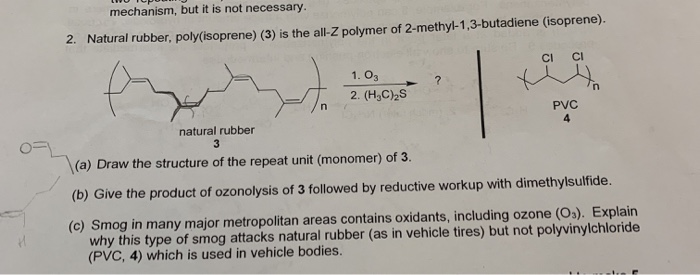
The monomer of natural rubber is isoprene.
Isoprene was identified as the major endogenous hydrocarbon of.
Natural rubber is insoluble in water.
The most abundant natural monomer is glucose which is linked by glycosidic bonds into the polymers cellulose starch and glycogen.
Thus the manufacturing process of natural rubber starts by mastication.
Elastomers for the manufacture of rubber tires automotive parts gaskets footwear adhesives and flooring 1.
Natural rubber is collected in ready polymerized form.
Polyisoprene a polymer of isoprene c5h8 that is the primary chemical constituent of natural rubber of the naturally occurring resins balata and gutta percha and of the synthetic equivalents of these.
Mastication makes the rubber softer.
A polymer may be a natural or synthetic macromolecule comprised of repeating units of a smaller molecule monomers.
Types of polyisoprene that are used as natural rubbers are classified as elastomers.
Isoprene is a natural monomer that polymerizes to form natural rubber most often cis 1 4 polyisoprene but also trans 1 4 polymer.
Here the monomeric units are distributed in a regular alternating fashion with nearly equimolar amounts of each in the chain.